The Human Was Always the Next Ceiling.
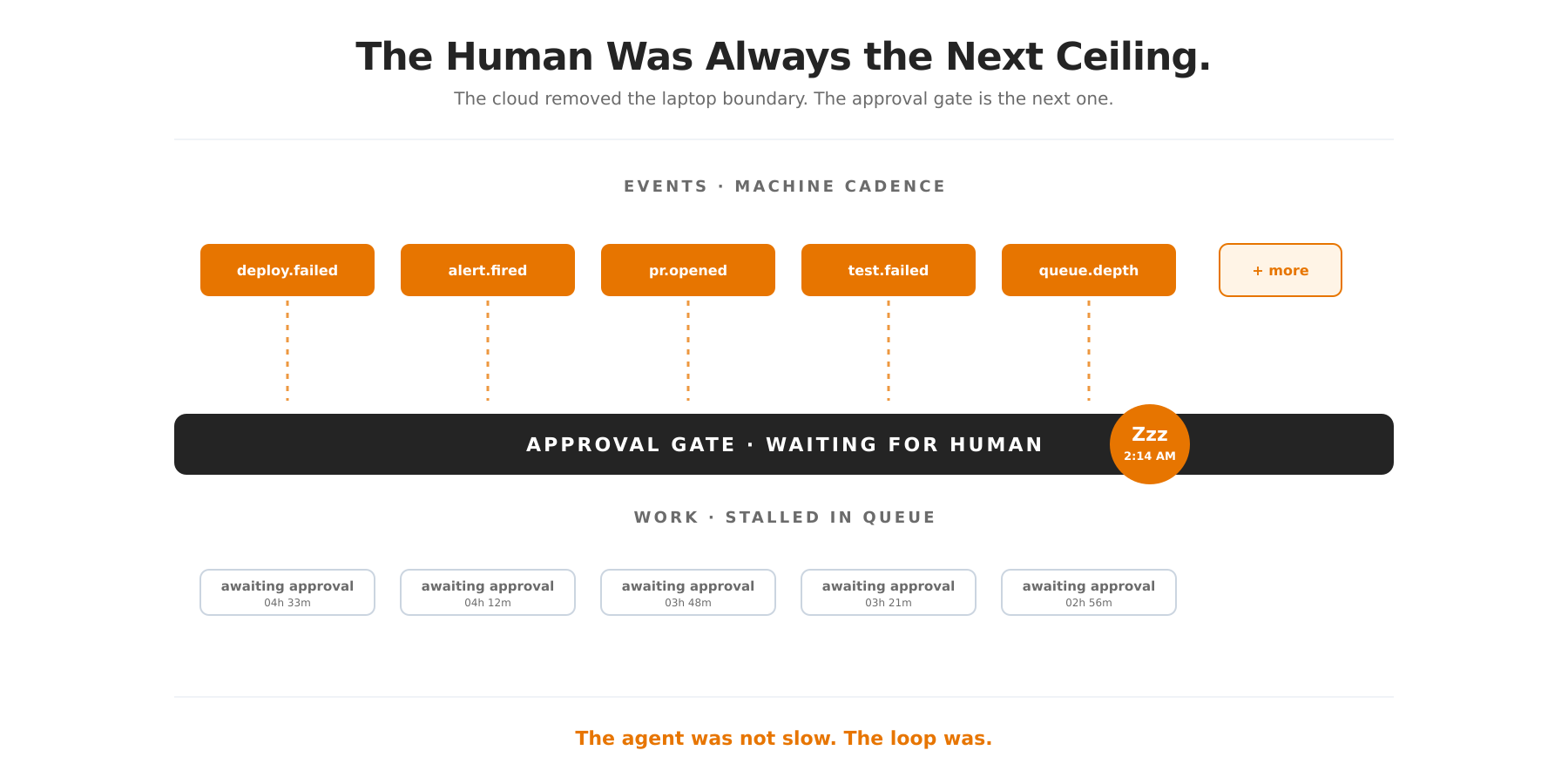
A monitoring system fires at 2:14 AM. A payment service is silently failing. The agent watching the queue knows what to do. It has the runbook, the credentials, and the rollback command ready.
It does not run.
The workflow says: wait for human approval. The on-call engineer is asleep. The Slack ping sits unread. By the time someone responds at 6:47 AM, four hours of transactions have failed and the agent has been holding the fix the entire time.
The agent was not slow. The approval loop was.
In The Session Was Always the Ceiling, I wrote about the boundary nobody saw. Local agents stop when the lid closes. The fix was to move execution off the session and into the cloud.
That removed one ceiling. There is another one directly above it.
The next ceiling is not technical. It is the human standing in the middle of the loop, asked to approve work they cannot meaningfully evaluate, at a cadence their biology cannot sustain.
This post is about that second ceiling, and what changes when you stop building around it.
The Comfort Phrase
Every AI strategy deck from 2024 used the same three words: human-in-the-loop. It was the organizational safety blanket. AI would do the cognitive heavy lifting. A human would retain authority over execution, validation, and the final call.
It was the right answer in 2024. The agents were unreliable. The tools were thin. The blast radius was unknowable. Keeping a human in the middle of every decision was prudent.
It is the wrong answer in 2026. Not because the human disappeared. Because the loop did.
The problem is not that agents lack judgment. The problem is that synchronous human approval is structurally incompatible with the systems we are now building. Background agents fire on events. Events arrive at machine cadence. The human in the middle is no longer a safety mechanism. The human in the middle is the latency.
Human-in-the-loop was the right answer to a question the architecture no longer asks.
The Math of Sleep
The disparity is not subtle.
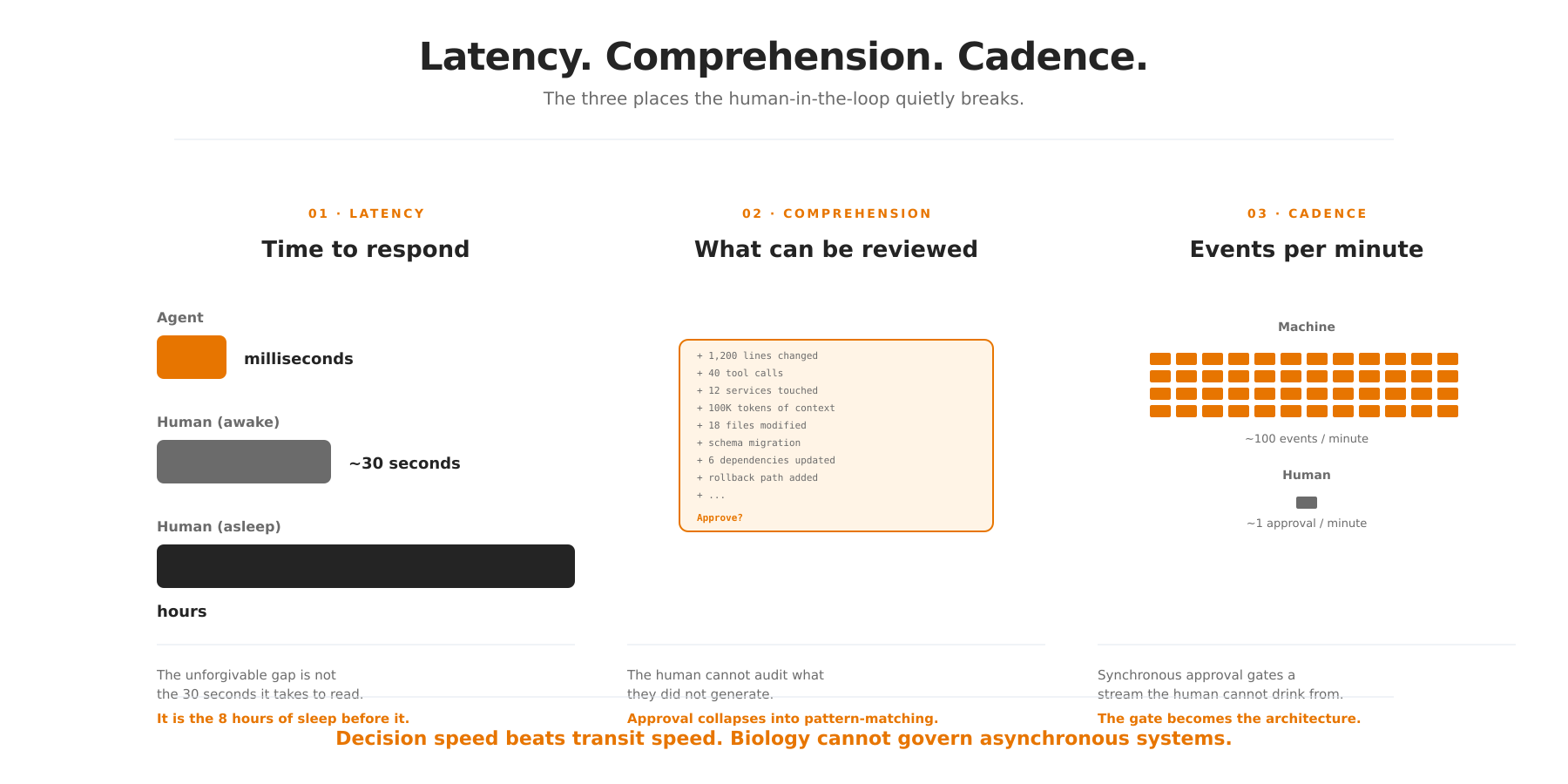
A modern agent processes thousands of decisions per second. A human can read, comprehend, and approve a structured alert in roughly thirty seconds, maybe a minute with context. Already a four-orders-of-magnitude gap. That part you can almost forgive.
The unforgivable part is biology.
A continuously running agent has no circadian rhythm. It does not sleep. It does not commute. It is not in a meeting. When something happens at 2:14 AM, the agent perceives it at 2:14 AM. The human perceives it whenever they next look at Slack, which on a good night is six hours later and on a bad night is the next morning.
The delay is not the thirty seconds it takes to read the alert. The delay is the eight hours of sleep that precede it.
You can dress this up with PagerDuty rotations and aggressive escalation paths. None of it closes the gap. It just distributes the cost across more humans. Someone is still being woken up at 2 AM to approve something the agent already knew how to fix.
The only honest answer is: stop putting humans on the critical path of decisions the agent is qualified to make.
Decision speed beats transit speed. Biology cannot govern asynchronous systems.
The Review You Cannot Actually Do
There is a quieter problem underneath the latency one.
Even when the human is awake, alert, and looking at the screen, the review they perform is rarely the review the system thinks they performed.
Picture the scenario. An agent has synthesized signals from twelve different services to recommend a database schema migration. The pull request is 1,200 lines. The reasoning involved 40 tool calls and a hundred thousand tokens of context the human never saw. The Slack message reads: Approve?
The human has two options. Slow down, reconstruct the agent’s reasoning from scratch, and genuinely validate it. This takes hours, possibly days, and defeats the entire point of running the agent in the first place. Or skim the diff, recognize the patterns that look familiar, and click approve.
In practice, almost everyone clicks approve.
This is not negligence. It is the only rational response to an impossible task. The human cannot audit what they did not generate. Under volume pressure, with dozens of approvals per day, the review collapses into pattern-matching. Familiar shapes get rubber-stamped. Genuinely dangerous changes that happen to look familiar slip through. Genuinely safe changes that happen to look novel get blocked.
The approval gate becomes theater. It satisfies the org chart. It does not change outcomes. Worse, it provides false comfort that something is being verified when nothing meaningful is.
Review at machine velocity is theater, not safety.
Chat Was the Prototype. Events Are the Production.
If synchronous human approval is the bottleneck, the architectural answer is not to make humans faster. It is to remove them from the synchronous path entirely.
Chat-based agent interfaces, the ones that defined 2024, were a prototyping surface. A human types a request. The agent responds. The human reads the response. The human types the next request. The whole interaction is gated by human typing speed and human attention. It works fine for two-turn conversations. It does not work for systems that need to handle a hundred events per minute.
Event-driven orchestration is what replaces it.
In an event-driven system, an agent does not wait for permission to act. It subscribes to a stream: deploys, errors, customer signals, market data, repo events. When a relevant event arrives, the agent fires, executes, writes its result to a durable run, and returns. Other agents subscribe to the result. The chain advances without anyone in the middle waiting on anyone else.
The agents Stripe and Uber built do not live inside a chat window. They live inside the event stream. Slack is a way to inspect runs, redirect them, or kick off new ones. Slack is not where the work happens. The work happens in the event loop, continuously, while humans are doing something else.
This is the same architectural shift the streaming data world went through a decade ago. Batch jobs that required human supervision became streaming pipelines that ran themselves. The supervision moved to dashboards, alerts, and post-hoc audits. Nobody mourned the loss of the nightly cron approval meeting.
Chat was the prototype. Events are the production.
Where Humans Actually Belong
Removing humans from the middle of the loop is not the same as removing them from the system. It is the opposite. It frees them to do the work only they can do.
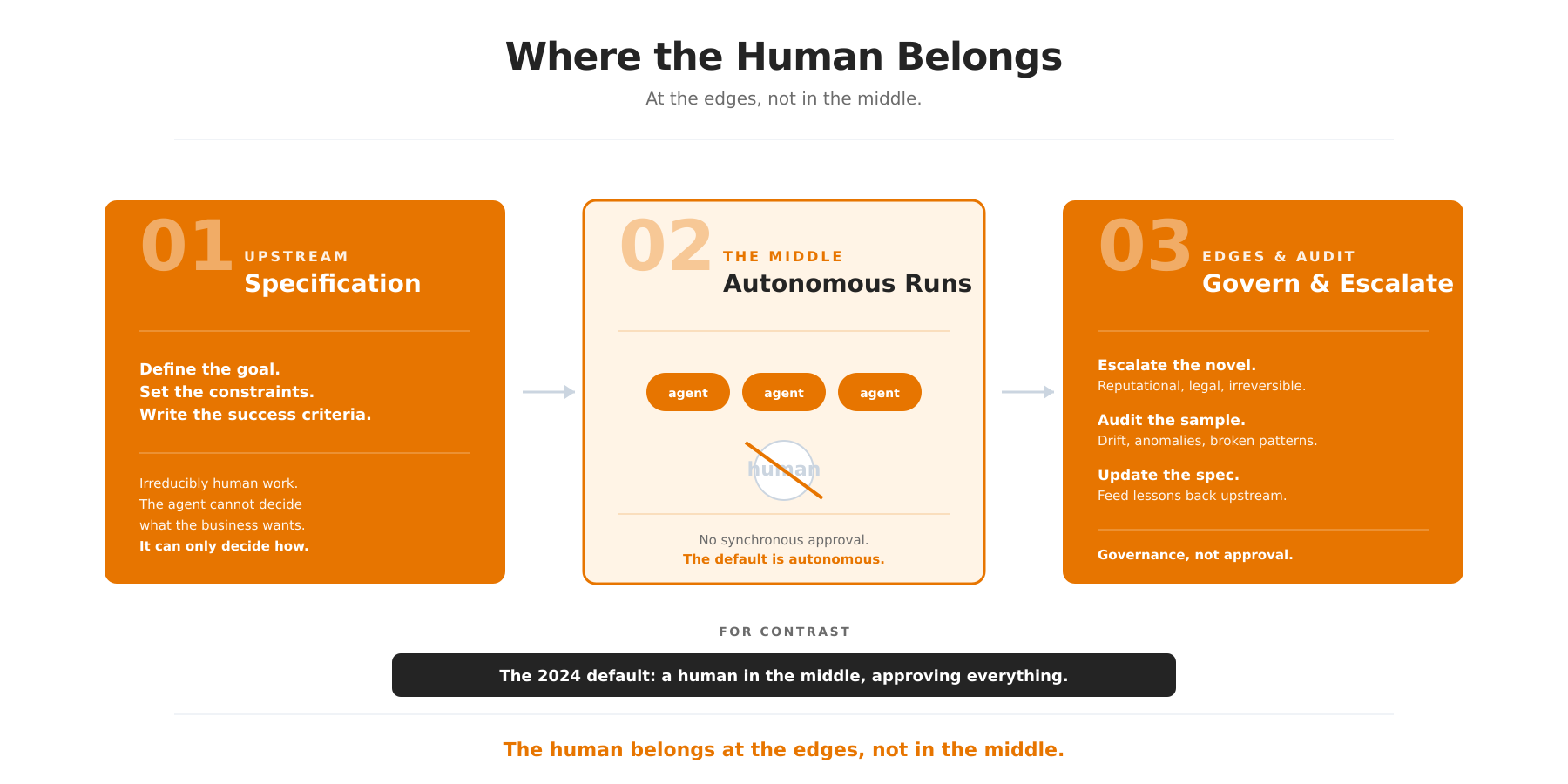
There are three places a human still belongs.
Upstream, in specification. Before any agent runs, someone defines the goal, the constraints, the success criteria, and the boundaries. This is irreducibly human work. The agent cannot decide what the business actually wants. It can only decide how to get there once told. The quality of the run is bounded by the quality of the spec, the same way it is bounded by the quality of the prompt. I wrote about this in Procedure Over Intelligence. Encoded constraints, not real-time supervision, are how reliable agents get built.
At the edges, on escalation. Some decisions genuinely require human judgment. Novel situations the agent has not seen. Reputational risk. Legal exposure. Cases where the system explicitly cannot decide and should not pretend to. The system should be designed to recognize these cases and surface them with full context. Not every event. Not every approval. The handful that actually warrant a human.
After the fact, on audit. Runs leave durable artifacts: logs, decisions, tool calls, outputs. Humans review samples, look for drift, update specs, retire patterns that are not working. This is governance at the system level, not at the request level. It scales. Real-time approval does not.
These three roles are not bonuses. They are where human time should have always been spent. The reason it is not, in most organizations, is because humans have been busy clicking approve on decisions a machine could have made unsupervised.
The human belongs at the edges, not in the middle.
What This Means If You Are Building Now
Three questions sit upstream of every other design decision.
Which decisions in your current workflow actually require human judgment, and which require human presence only because that is how the system was built? The honest answer is usually that 80 percent of the approvals are presence, not judgment. Those are the ones to automate first.
What is the cost of being wrong, and is it recoverable? Reversible decisions can run unsupervised, with humans reviewing the audit log. Irreversible decisions, like deleting production data or sending a customer-facing communication at scale, deserve a hard gate. The gate is the exception, not the default.
Where does the agent know it does not know? A well-built agent has explicit uncertainty. It can flag when the request falls outside its training, when tool calls return ambiguous data, when the confidence is low. Those are the escalation points. Everything else runs through.
The pattern is the same one Building the Control Layer pointed at. The harness decides what the agent can do, what it must escalate, what it logs, and what it owns. The human appears in the harness’s design, not in every one of its runs.
The default should be autonomous. The exception should be human.
The Loop Was Always Temporary
The history of every reliable system is the same arc. Manual at first. Then partially automated with human approval. Then fully automated with human governance. Air traffic control. Power grid load balancing. High-frequency trading. Modern surgery’s anesthesia delivery. Each one passed through a phase where keeping a human in the middle felt obviously right, and then through a phase where keeping a human in the middle became the limiting factor.
Software is in the second phase now.
Background agents removed the session ceiling. The work moved off the laptop and into the cloud. The next ceiling is the one we built in 2024 when we wrapped every agent in a synchronous approval gate. That ceiling exists because we did not yet trust the system. We have spent a year building the harness, the sandboxes, the audit trails, the governance, the spec discipline. The trust now exists in the infrastructure. The approval gate is what is left over.
The org chart still has a human in the middle. The architecture should not.
Removing the human from the loop is not a removal of judgment. It is a relocation of judgment. Out of the middle, where it slows everything down and verifies nothing. Into the upstream, where it shapes outcomes. Into the audit, where it catches drift. Into the escalation path, where it actually matters.
Stop asking how to make humans faster. They will not get faster. Start asking why the system stops the moment they look away.
The session was the first ceiling. The loop was the next one.
Resources & Next Steps
- Task-Completion Time Horizons of Frontier AI Models (METR)
- The Future of AI Agents Is Event-Driven (Confluent)
- Related post: The Session Was Always the Ceiling.
- Related post: Building the Control Layer
- Related post: Procedure Over Intelligence: Building Reliable AI Systems
- Related post: The Bottleneck Moved. Most Teams Have Not.